
Understand Your Market
Go to Content
Introduction
Understanding your market is the foundation of an effective enrollment strategy. This action plan helps enrollment teams build market awareness, define your competitive landscape, identify growth opportunities, and strengthen your brand to drive sustainable enrollment results.
Whether you’re a new enrollment professional or more seasoned, we’ve got you covered. Using the table of contents above, start at the level that best suits where you’re ready to glean new strategies.
 Level 1
What is the Market?
Before you can decide where to recruit, how to message, or what to invest in, you need a clear understanding of the market you’re working in.
In this context, the market is more than a list of high schools or competitor institutions. It includes the students who could reasonably consider postsecondary education, the environments they’re growing up in, and the forces shaping their decisions long before they encounter your institution.
This chapter focuses on market awareness — understanding what’s happening around you so decisions later in the funnel are grounded in reality.
The Market Extends Beyond Your Institution
It’s common to define the market narrowly: by geography, by peer set, or by historical enrollment patterns. But those definitions often miss the bigger picture.
The market is shaped by:
- Demographic change, including population shifts and uneven growth across regions
- Declining or flattening college-going rates in some areas
- Evolving student sentiment, particularly around value, outcomes, and flexibility
- Greater family and influencer involvement in decision-making
These forces influence whether students pursue postsecondary education at all — and which institutions they consider viable. In addition, while these trends are national, their impact is always local. Two institutions in neighboring states, or even neighboring counties, may experience these forces very differently.
It is important to remember that if your results are changing, it may not be because your strategy is broken. The market itself may be shifting, requiring a different approach.
Start Broad, Then Get Local With Trusted Market Data
Many enrollment pressures are national, but they play out differently depending on where you recruit.
To understand your market, broadly available data sources can be a great place to start, including:
- IPEDS, to establish enrollment and completion context
- Regional or state-level data to understand population trends (e.g., WICHE or local education alliances)
- Local insight from K–12 or community partners to understand pipeline shifts before students reach senior year
These sources help institutions establish a baseline: what is happening in your backyard and how that compares to broader patterns and national narratives.
Utilizing these resources before adjusting tactics can help you determine whether external conditions — not internal performance — are driving change in your market.
PRO TIP
How Encoura Supports Market Awareness
Encoura Insights Cloud™ brings together Market Analysis and Competitive Insights in one place, so teams don’t have to piece together multiple data sources to understand their markets. By combining demand trends with peer-level funnel comparisons, Insights Cloud provides the context needed to align recruitment strategies before adjusting tactics.
Market Awareness Creates Alignment
When teams don’t share a common understanding of the market, strategies can become fragmented. Outreach, travel, messaging, and digital efforts may all pull in slightly different directions.
Market awareness creates a shared starting point. It helps teams align expectations, prioritize effort, and make more intentional trade-offs when resources are limited.
Clear market context reduces guesswork and helps teams explain why certain decisions are being made.
Related Resource
Enrollminute™: 3 Ways To Use Data To Understand Your Market Better
This short Encoura Enrollminute video highlights practical ways teams can use enrollment and market data to move beyond assumptions and better understand the forces shaping their recruitment landscape.
Why Market Awareness Comes First
Market awareness isn’t about predicting the future. It’s about reducing blind spots. When institutions understand the market they’re operating in, they are better positioned to:
- Set realistic enrollment goals
- Focus resources where they can have the most impact
- Adapt strategy before challenges become urgent
This foundation makes the next step, defining your specific market, more effective.

 Level 2
Defining Your Market
Once you have a clear view of the broader market and the forces shaping demand, the next step is narrowing the focus. Defining your market means understanding where your institution actually competes today — geographically, demographically, and perceptually.
While Level 1 helps you understand what’s happening around you, Level 2 focuses on what that reality means specifically for your institution and where your efforts are most likely to make an impact.
Your Market Is More Than a Map
It’s tempting to define your market by drawing boundaries — a state, a region, a travel territory. But geography alone rarely tells the full story.
Your true market is shaped by:
- Where your enrolled students actually come from
- Where students recognize and consider your institution
- Which institutions students view as realistic alternatives
Two institutions recruiting in the same area may experience very different outcomes based on brand awareness, program mix, affordability perceptions, and institutional fit.
Defining your market requires looking beyond where you recruit to where students are willing to choose you.
Use Your Enrollment Data as a Starting Point
Your enrollment funnel already holds valuable insight into your market. By reviewing enrollment outcomes over time, teams can begin to see:
- Which regions consistently produce enrolled students
- Where interest drops off before enrollment
- How patterns shift across cycles
This analysis helps replace long-held assumptions with evidence and gives teams a clearer picture of what’s working — and where challenges persist.
Understand Where Your Brand Competes — and Where It Doesn’t
Defining your market also means being honest about how your institution shows up in students’ minds.
Helpful questions to consider include:
- Where is your institution well known versus unfamiliar?
- Where are you actively considered alongside competitors?
- Where does awareness need to be built before recruitment efforts can succeed?
Brand presence often explains why some markets perform efficiently while others require more sustained effort to move students from interest to enrollment.
Understanding these dynamics helps teams set realistic expectations and align messaging accordingly.
Better Understand Brand Presence Within Your Market
Better understanding brand presence starts with looking beyond internal perspectives to see how students recognize, evaluate, and compare institutions. Tools like the Eduventures® Prospective Student Brand Research™ help teams see where their institution is well known, how it compares to competitors, and where perception may be limiting recruitment success.
This kind of insight helps move conversations from assumptions to evidence, especially when defining where recruitment efforts are most likely to resonate.
Please rate your perception of the quality of [University] in the following areas: 1-5 Scale of “Poor” to “Excellent”
Percentages displayed below represent students who rated the selected institution as “Excellent” or “Very Good.”
Segment The Market To See Opportunity and Sharpen Focus
Market definition becomes more actionable when you look beyond geography alone. Segmenting your market by Student Mindsets™, academic interests, or brand positioning can reveal:
- Students who are naturally aligned with your institution
- Markets where your message resonates most clearly
- Areas where differentiation matters most
Segmentation helps teams move from broad coverage to intentional focus, allowing recruitment and marketing efforts to be more targeted and effective.
PRO TIP
Use Student Mindsets to Sharpen Market Definition
Layering in the Eduventures® Student Mindsets helps you move beyond geography to better understand who makes up your market. By grouping students based on motivations, priorities, and decision-making behaviors, Mindsets reveal which students are most naturally aligned with your institution — and where your messaging or outreach may need to adjust to better connect.
From Market Definition to Strategic Direction
When your market is clearly defined, decisions become easier and more aligned:
- Where to defend existing enrollment strength
- Where to deepen engagement and investment
- Where expectations may need to be adjusted before expansion
This clarity ensures that future strategies are grounded in who your institution truly serves — not just who it hopes to reach.
Defining your market sets the stage for the next level: identifying opportunities within your current market and determining where growth is most realistic.
 Level 3
Exploring Opportunities Within Your Current Market
Now that we’ve defined your institution’s primary market, how do you find and understand new opportunities for student search and engagement there?
One of the most effective (if not the most effective) ways to pinpoint your best market opportunities is to use predictive models. Predictive models in student search strengthen the top of your funnel by finding students with qualities that show they are most likely to be interested in your institution.
Pinpoint Opportunities With Predictive Models
Let’s take a closer look at the two types of predictive models that help you find key students in your primary geographic or program markets: market opportunity models and prospect-to-enroll models. (To see a deep dive into the different types of predictive models available to institutions, including these two, check out Chapter 3 of our Optimize Your Funnel Action Plan.)
Market Opportunity Models
Market opportunity models (aka prospect-to-interest models) point out both offensive and defensive opportunities that your institution has at the very top of the funnel. When looking for new students (offensive approach), this model identifies students in your market(s) who are interested in colleges similar to yours, as well as students who are willing to travel farther from home for college. This prospect-to-interest strategy empowers you to reach out before your competitors to connect with students who are most likely to engage with your school.
An often overlooked benefit of market opportunity models is that they can also help you keep interested students from exploring other colleges (defensive approach). By using these models to identify local students who might be willing to travel farther out of your area for college, you can proactively engage those students by communicating the benefits of your school and geographic area.
Prospect-to-Enroll Models
You are most likely familiar with prospect-to-enroll models, like Encoura Smart+®. These models find students in your market who have the highest likelihood of enrolling in your specific institution. The biggest opportunities in your market are often students with medium to high model scores (meaning they have a modest to high likelihood to enroll). Engage these students to have the biggest return on your student search efforts.
While we’ll discuss strategies for expanding into new markets in the next chapter, it’s important to note that prospect-to-enroll models can also help you identify new markets. By examining where you have students with high model scores, you can explore if there are geographic areas outside your primary market where these students are more concentrated. Consider adding these markets to your search efforts.
Make Retention a Priority Too
After ensuring that you have a strong understanding of your market and how to strengthen your top-of-funnel strategies there, it’s important to ensure that these strategies align with what makes sense further down the funnel. Are the students you’ve found who are likely to enroll also likely to retain at your institution?
Partner with your campus offices that support retention to understand which types of students are succeeding at your college. If your search strategies are reaching students who don’t fit the profiles of students you are retaining, work together across departments to consider how you can implement resources or processes to better serve and retain these students. This strategy will strengthen your reputation and recruitment efforts both in your current and your new markets.
Once you’ve made decisions about which opportunities to pursue in your current market — and ensure you are retaining the students you are engaging — your next step is to consider expansion into new markets.
Quiz: Which Predictive Model Is Right for Your Institution This Year?
Better understand your market, funnel, and opportunities by taking our three-question quiz. Your result will reveal which predictive model is best designed to empower your team to hit your enrollment goals this year.
Take Quiz Level 4
Expanding Into New Markets
After solidifying your understanding of your current market, it’s time to explore how your team can achieve or surpass your enrollment goals by expanding into new markets.
When considering this expansion, it’s important to define your goals and your capacity. Ask yourself:
- Are we trying to grow enrollment in general, or do we have specific institutional or enrollment goals that necessitate focusing on certain populations or programs?
- What is my staffing situation? Does my team have bandwidth to pursue new markets without neglecting our current ones?
- What is my budget? Do I have extra funds for the travel season? Do I have money I can apply to grow my digital marketing efforts in new areas?
- Do we have sufficient financial aid that we can offer to new students so that our recruitment efforts result in enrollment decisions?
- Do we have systems in place to support students from new markets so they retain?
Once you’ve assessed your situation and determined that you have the direction and resources needed to expand in new markets, your next step is to set your strategy.
Early Engagement Is Critical
Don’t try to reach seniors in new markets; they’ve already been engaging with schools and probably have their decisions set. To be successful in new markets, it’s necessary to start by reaching sophomores and their families — or even younger students.
When did you start thinking about the colleges that your child might apply to?
Families are one of the biggest college influencers for students today. As you can see in the figure above, nearly three-quarters of parents/guardians are considering colleges for their children in 10th grade or earlier. It’s essential to meet those families when they begin searching to gain brand recognition and loyalty.
A key way to engage those families at a top return on your investment is through digital marketing. (See specific strategies for family engagement in our action plan here.)
Investigate New Markets
After focusing on your institution’s larger goals and preparing to recruit early high school students, it’s time to strategically select the specific markets where you want to expand recruitment.
Reach Out to Students Already Connected to Your School
If you have a limited budget, start considering new markets with students who already have a connection to you. Where do you have students who are expressing unprompted interest in your college? Where are students who are affiliated with your institution through your current students, faculty, or alumni?
How Encoura Connects You
With Your Best-Performing Students

Declared Student Connection™
Connect with students who have already expressed interest in your institution and are 6x more likely to enroll.

Affinity Connection™
Build on prospective students’ existing foundations of familiarity and connectedness with your school via alumni, faculty/staff, and current students.

Undiscovered Students
Identify and engage students not being contacted by other colleges to boost your enrollment and create access for all students.
Use Your Institutional Data
Using your CRM, or tools like Encoura Insights Cloud that visualizes your current and past enrollment data, explore where you’ve organically had interest in geographic areas outside of your primary market.
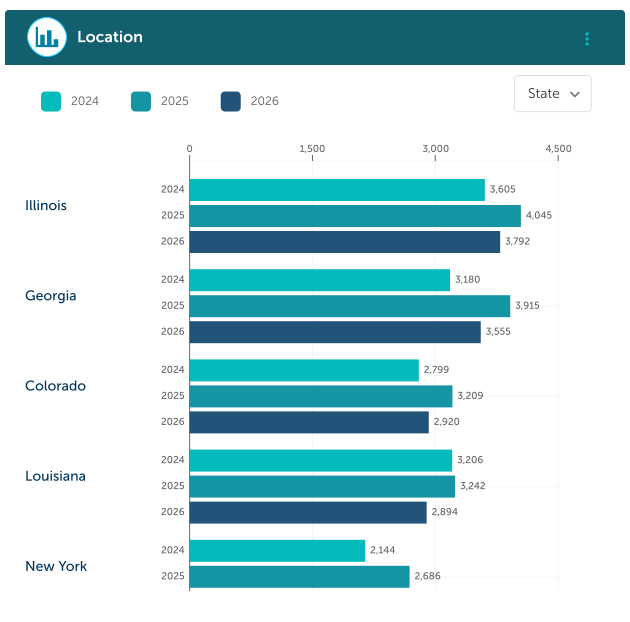
Source: Sample inquiry-to-enroll numbers in Enrollment Funnel Analysis in Encoura Insights Cloud.
Tap Into Your Predictive Models
Considering the new markets you just identified with higher levels of student interest, leverage your market opportunity and inquiry-to-enroll predictive models to find students in these new markets who are the most strategic for you to engage. (See Level 3 for a recap of these models).
These two types of models are also a great way to identify more potential new markets. Check which students are scoring highly for your institution. Are they concentrated in a certain area? Consider adding that market to your list.
Assess the Competition
Once you have identified your new markets, analyze your competition for those students. Which schools are also trying to recruit in those areas? Is your enrollment and marketing team ready with custom messaging that highlights your strengths and differentiates you from those colleges?
Align Your Programs
In addition to assessing your competition to strengthen your marketing, you want to assess that your academic programs are suited to attract and retain students from your new markets.
Research what programs students in your new markets are interested in, how the strength of your programs compares to your new competing institutions, and how you can best market them to your new audience.
By engaging students early, making data-driven decisions for which new markets to pursue, and aligning your programs and marketing accordingly, you’ll set up your team to successfully break into new markets that achieve your enrollment goals.
Determine Opportunities To Expand Your Enrollment With the Eduventures Program Strength Assessment
The Program Strength Assessment is a data-driven tool for higher education leaders to objectively evaluate their academic programs against internal and external benchmarks. Institutions use their tailored results to make strategic changes to their academic portfolios to drive future growth.
Learn More Level 5
Become a Leading Brand in Your Market
After successfully understanding your primary market and expanding into new markets, your team is probably asking, “How do I grow my brand equity and efficacy regionally, or even nationally?
Know Your Brand
The first step to grow your brand is to understand your brand. Ask yourself:
- Who is my institution?
- Who defined that brand for me?
- Would prospective students and families agree? How do I know?
While every institution and organization develops its mission, vision, values, and brand guidelines, it's essential to pulse check with your audience to see if that’s the brand you’re truly communicating externally.
Are you regularly checking in with prospective students to see what words they use to describe your school? Participate in research that surveys this audience, like the Eduventures Prospective Student Brand Research. Not only does this research reveal successes and discrepancies in your brand efforts, it will strengthen your recruiting and marketing teams with Student Mindsets — college-bound student personas that reveal which students your institution best attracts and enrolls.
Own Your Brand Neighborhood
In today’s higher ed climate, understanding your college’s Brand Neighborhood — its levels of distinction and differentiation — becomes critical for winning market share.
Your Brand Neighborhood is your brand category in the eyes of students based on your institution’s primary brand identity and secondary characteristics — one of four public institution Neighborhoods or four private institution Neighborhoods.
In the clip below, Eduventures Principal Analyst Kim Reid shares the dimensions and descriptions of the student-defined Brand Neighborhoods. (Click here to see her full webinar that details the entire set of public and private institution Neighborhoods.)
In order to achieve your enrollment goals in the current climate, stop asking, “Who do we want to be?” and start asking, “How can we serve our students better than anyone else in our current Neighborhood?” This latest research from Eduventures shows that in a contracting market, clarity and focus — not brand reinvention — will separate the institutions that survive from those that will struggle.
Know Your Competitors
Speaking of competition, what are your competitors doing? How are they recruiting? How are they communicating? Most importantly, how can you outperform them in these areas? How can you reach students earlier and distinguish your brand?
Another important insight to consider is where students who engage with both your school and your top competitors end up enrolling — whether that’s your school, theirs, or a third option. You can get this information from surveying your admitted students or get more widespread data with enrollment technology like Encoura Insights Cloud.
Knowing where your shared prospective students decide to enroll helps you adjust your strategy to encourage future shared students to choose your college. For example, if a large number of students interested in your school and your top competitor actually end up enrolling in community college straight out of high school, develop transfer agreements with that college to give yourself a competitive edge and enroll these students later.
Telling Your Brand’s Story
Successful schools tell their story well. Storytelling is a top skill of colleges with leading brands, and one your team should develop to join them. To lead your market, it’s critical to be able to not only find, but connect emotionally, with the right students.
After truly understanding your brand in the eyes of your audience, learn how to excel at storytelling and channel that compelling story through your marketing — both traditional channels and digital ones. This will empower you to reach students effectively and earlier, when their brand loyalty is developing. When storytelling is done well, your college will be the one that students grow up dreaming about attending.
Continue Strengthening Your Strategies With the Engage Your Students and Families Action Plan
How are you engaging students and their parents/guardians in the search, application, and acceptance stages? This action plan, divided into five levels, will help your team explore how to evaluate what you’ve currently put in the market — and adjust to include other influential family members.
Start Next Action Plan