

The Georgia General Assembly is considering a 10% cut to per-credit-hour funding for online courses, asserting that online courses cost less for higher education to deliver.
Local schools say any reduction reflects a misunderstanding of what it takes to stand up quality online courses and programs. However, since most online courses are taken by students who also spend time on campus, it is impossible to disaggregate costs.
If Georgia is rethinking long-held assumptions about online learning, more states are likely to follow. Are lawmakers right?
Just an Old Sweet Song
Thirty years ago, when online learning was new, how it was different got the most attention: no campus and no conventional classes or instruction. To win acceptance, advocates doubled down on similarities to show its academic respectability: same faculty, same admission criteria, and the same accreditation as their campus counterparts. “Sameness” also extended to cost and price.
Today, Georgia lawmakers are not convinced.
Prior to fiscal 2027 budget adoption, the state senate called for differential funding at public colleges and universities by modality. Online courses would have to generate 10% additional credit hours to earn the same amount of funding as campus courses. For every public dollar devoted to a campus-based course, an online course would earn just 91 cents. Lawmakers argue that online courses are less expensive to deliver, although they have offered no public evidence.
Why are Georgia lawmakers mulling this move now? The final budget included a $34 million reduction in appropriations for the University System of Georgia, but it is not yet clear whether this will ultimately be achieved through a modality-driven formula change. The state senate has formed a committee to examine online learning costs.
The budget also featured a new $325 million needs-based aid program for college students, making online funding reductions one possible way to offset the cost. The governor also permitted tuition increases for public colleges and universities following a freeze the year prior.
Online Learning’s Hidden Superpower
While cuts might be necessary to balance the budget, are Georgia’s lawmakers on to something about lower online costs?
Figure 1 shows average spend per student at public four-year schools by online enrollment intensity. The percentages along the bottom reflect the proportion of students who are in fully online courses.
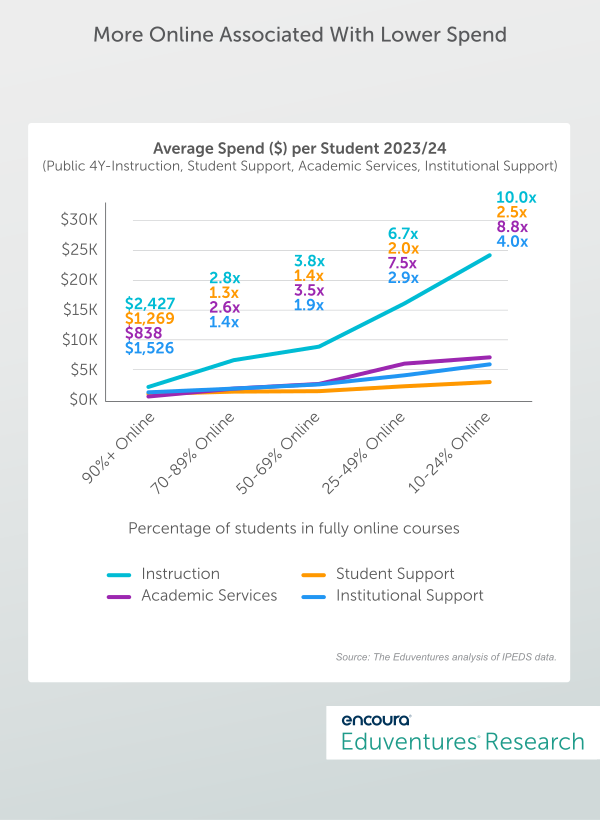
Figure 1.
Figure 1 makes a strong case that online learning tends to lower institutional spending: the greater the online enrollment intensity, the lower the average spend. Public schools where less than a quarter of students are fully online spend 10 times more per student on instruction, for example. This supports the legislative instinct that online costs less.
But Figure 1 only covers fully online students. As critics of the proposed Georgia cut note, most students who enroll in online classes also attend on campus. The finances of such mixed models are poorly understood and practice is inconsistent. Federal data does not quantify the number of credit hours taken online, obscuring any association with reduced spending. Comparable Georgia data does not appear to be publicly available either, though lawmakers may have access to unpublished numbers.
The latest survey of online learning cost and pricing from the WICHE Cooperative for Educational Technologies (WCET) reports that most schools think online costs are at least as high as those on campus and charge the same for both modalities, though a minority report higher and lower online costs (and prices). The Changing Landscape of Online Education (CHLOE) project — a joint initiative of Eduventures, Quality Matters, and EDUCAUSE — found similar data.
But what if the mainstreaming of online learning has already enabled colleges and universities to manage costs?
Net state appropriations, nationally and in Georgia, have not kept pace with institutional spending. Between 2005 and 2024, total net spending at U.S. public four-year schools grew 46% (vs. 16% in Georgia) while state appropriations were flat in real terms. Schools turned to tuition hikes and other private funding to close the gap. But did they also cut costs?
Figure 2 tracks average instructional spend per student at public four-year schools over the past two decades (U.S. vs. Georgia), controlling for inflation.
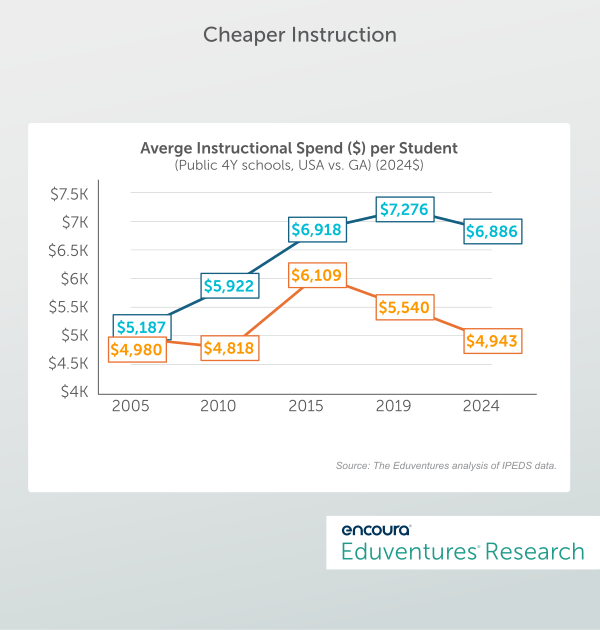
Figure 2.
Average instructional spend per student peaked in 2015 and then fell modestly nationally but sharply in Georgia. In 2005, four-year public schools in Georgia and across the U.S. devoted similar amounts to instruction per student. Twenty years later, Georgia’s inflation-adjusted figure was slightly below its 2005 baseline and 28% lower than the national average.
Of course, the post-2015 period is when online learning truly started to mainstream across higher education. Online is likely part of the explanation, but it is hard to prove. Broader demand and cost pressures may also have played a role, not to mention greater use of adjunct faculty, larger class sizes, and the dual enrollment boom.
Why is per-student instructional spend in Georgia down so dramatically?
The state’s longstanding investment in low-cost online courses and programs (eCore, eMajor, and FreeCampus) fits the pattern. While the University System of Georgia (USG) no longer publishes online enrollment data, about 10% of USG students in the pre-pandemic period took an eCore (general education) online course. Today, the figure is likely 20% or higher. IPEDS reports that 61% of public sector undergraduates in Georgia in 2024 were enrolled in at least one online class, consistent with the national average. Georgia Tech’s pioneering low-cost online master’s degrees are another piece of the puzzle.
Without online learning, could Georgia public schools have grown enrollment 71% over 20 years but held net instructional spend per student flat?
The Bottom Line
Georgia lawmakers are not wrong that online learning can reduce institutional costs. There is circumstantial evidence that the modality helped public schools in the state drive instructional spending far below the national average.
But cuts may invite unintended consequences. Lower funding may reopen allegations of online inferiority and encourage schools to downplay online courses, costing taxpayers more. Schools might raise fees to offset lost funding, potentially dampening student demand — and many students discouraged from online enrollment may not enroll at all.
Lawmakers in the Peach State need to consider that two decades of online learning expansion helped keep a lid on appropriations, and that formula changes carry risks. A more strategic approach might be for the state to fund short-term incentives for schools to deepen investment in high-quality online courses and programs, stipulating that cost reduction is required — and not at the expense of student outcomes. (Could lawmakers point to investments in eCore and eMajor and say, “job done?”)
Online learning cannot stay in start-up mode forever. The modality has proven its value as an engine of convenience and enrollment growth, but it will be asked to do more to address higher education’s other big challenges: cost and outcomes. Institutional claims that online “cannot” lower costs are difficult to square with the data and are unlikely to persuade hard-pressed lawmakers. More attention to the economics of online and hybrid learning is essential if the gap between lawmaker instincts and school reticence is to narrow. A quality online course or program can take many forms, but the cost variable needs greater clarity.
Of course, cost savings must be considered alongside student outcomes, which are often weak for fully online students — among undergraduates at least. Poorer outcomes might give lawmakers additional incentives to cut funding.
Expect to see more states scrutinize funding by modality. The medium-term fiscal climate will offer plenty of motivation to find savings. But also expect to see schools tell a better story about the efficiencies online has already delivered — and the dangers of blunt funding cuts.
For more on this topic, please attend my keynote at the Eduventures Summit, "Online as a Strategic Asset: Making Modality Matter."

