

International graduate enrollment surpassed half a million students in 2024, but the era of sustained growth has clearly ended. Preliminary fall 2025 data showed a staggering 17% drop in new enrollments, reinforcing broader concerns already reshaping institutional enrollment strategy.
Heavy dependence on India and China, which together account for three out of five international graduate students in the U.S., has heightened international exposure as both pipelines soften.
What does the data tell us now, and how can institutions adapt to a more volatile and competitive reality?
The End of Growth
International students now account for a rising share of graduate enrollment. In fall 2024, they represented 17% of new graduate enrollment, which grew from 13% in 2019–2020. Yet beneath that long-term growth is a far more volatile story, particularly at the master’s level.
Figure 1 reveals that full-year international master’s enrollment totaled over 220,000 in 2018-2019, compared with about 133,000 doctoral students. While doctoral enrollment has remained quite stable, international master’s enrollment has fluctuated sharply over the past several years. During the pandemic, master’s enrollment fell to about 167,000 students before rebounding dramatically to nearly 320,000 in 2023-2024.
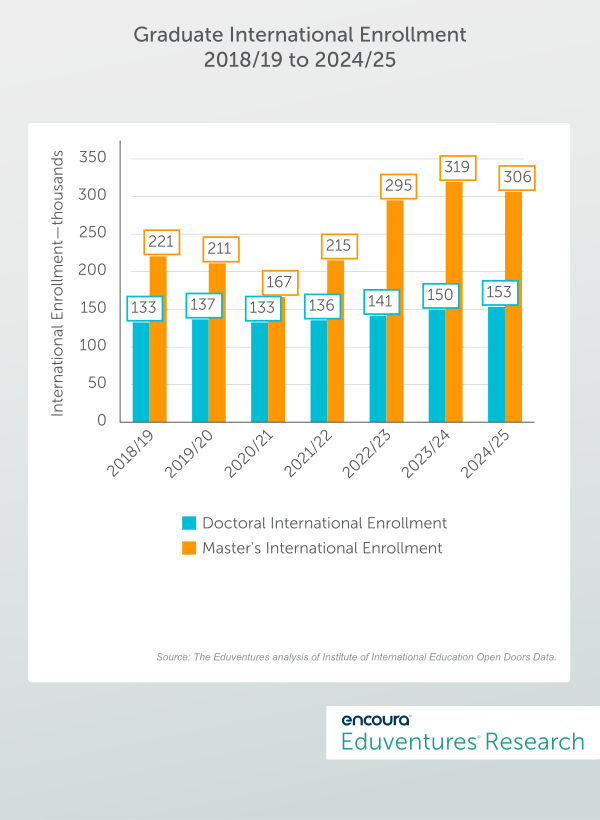
Figure 1.
What explains this recent boom in enrollment?
The answer goes back to 2016 when the international graduate enrollment decline coincided with the start of the first Trump administration, which positioned the U.S. as a less welcoming destination for many foreign students. That decline reversed under the Biden administration, as post-pandemic demand and a more favorable policy environment fueled a sharp rebound in both the master's and doctoral enrollments.
Institutions are now seeing another shift in the market. According to Open Doors 2024–25, 96% of institutions cited visa delays and denials as the primary driver of enrollment drops, while 67% reported that students increasingly feel unwelcomed in the U.S. Rising tuition, living costs, and geopolitical tensions are compounding those concerns.
The impact is particularly acute in STEM fields, where international students make up a substantial share of graduate enrollment. Because many STEM programs are expensive to operate, even modest enrollment declines can create immediate financial pressure for institutions already facing broader demographic and budget challenges.
The India and China Dilemma
International graduate enrollment surpassed half a million students in 2023-2024, but the market remains heavily concentrated. India and China alone account for 61% of the total. At the same time, the remaining market tells a somewhat different story.
Enrollment from all other places of origin combined — roughly 190,00 students — grew 4%, even as the overall international graduate market contracted by 3%.
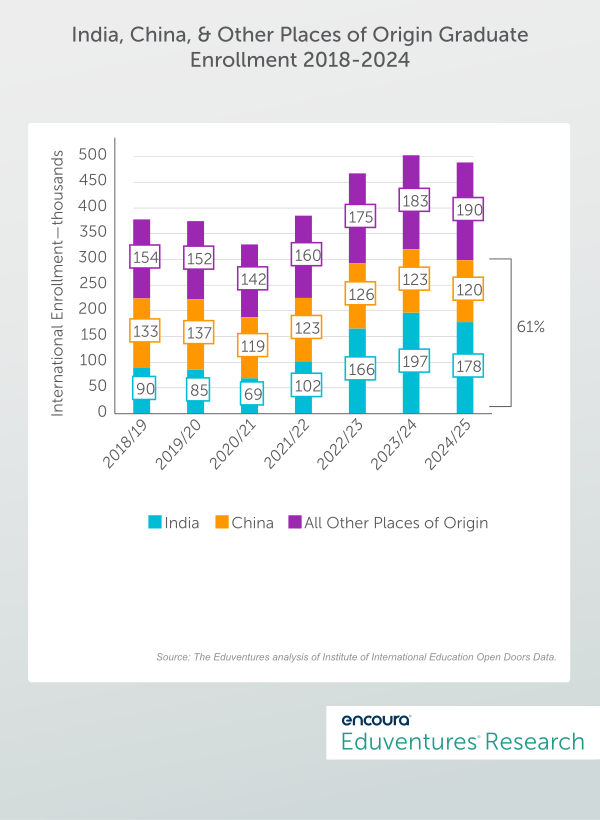
Figure 2.
That concentration has become a growing liability. Preliminary fall 2025 data showed a 17% decline in new graduate international enrollment and a 12% drop overall, with India and China expected to drive the bulk of those losses.
Both the DHS Student and Exchange Visitor and Open Doors data point to places of origin such as Nepal, Zimbabwe, Pakistan, Bangladesh, and Ghana as markets helping offset some of the decline from India and China. But these emerging markets come with important caveats. They are smaller, more price-sensitive, less predictable, and more dependent on specific recruitment channels or visa pathways. While these markets may help stabilize enrollment in the short term, they do not offer the scale or consistency institutions have historically relied on from India and China.
Not all institutions are experiencing this challenge. Those with diversified pipelines, strong brand recognition across multiple regions, and program portfolios aligned to global workforce demand are faring better. Those heavily dependent on a narrow set of places of origin or recruitment partners are feeling the strain first.
International graduate enrollment is no longer a rising tide lifting all boats. It is now a far more competitive and segmented market where institutional strategy matters.
The Bottom Line
Recent agreements between the E.U. and Canada with India are unlikely to help stabilize the largest international market in the near term. At the same time, heightened scrutiny of Chinese students by the second Trump administration will likely push more students toward destinations perceived as more welcoming.
Taken together, institutions that rely heavily on students from India and China will remain under pressure, as both markets are expected to continue contracting over the next several years.
Institutions cannot afford to wait for another policy reversal or assume the market will simply reverse course. This is a pivot point: international graduate enrollment remains sizable, but it is no longer a default growth strategy.
Where do we go from here? The strategy must shift from expansion to resilience:
- Assess institutional exposure. Build enrollment targets assuming flat or uneven international growth. Map the share of graduate enrollment and net tuition revenue tied to international students by program and place of origin.
- Prioritize operational flexibility. Deferrals are no longer a perk but an expectation. Nearly three-quarters of institutions offered deferrals to spring 2025 or fall 2026 to help students navigate visa hurdles.
- Strengthen internal pipelines. With new international recruitment becoming more difficult, 32% of institutions are prioritizing current international undergraduates as a pipeline into graduate study.
- Diversify beyond India and China. Future growth will come from smaller markets such as Nepal, Pakistan, Bangladesh, and Zimbabwe. But these markets require multi-year strategies that account for lower volume, greater volatility, and differing student support needs.
- Strengthen international positioning. Safety, belonging, and career outcomes are increasingly central to program value propositions. This means articulating support structures and strong post-graduation pathways.
- Balance STEM strength with program health. Given that international students make up over half of many STEM graduate programs, ensure these offerings are also well-positioned for domestic students. Programs that are overly dependent on international students should develop contingency plans for policy or visa disruptions.
International graduate students have helped stabilize U.S. graduate education through an extraordinary period of disruption. The question now is whether institutions will adapt to a more fragile and competitive reality of continuing to wait for a rebound that may never fully arrive.

