

The rise of the Bachelor’s of Science in Nursing (BSN) as the standard credential to become a registered nurse was driven by professional aspiration, employer preference, student demand, and patient outcomes. BSN-educated nurses are better prepared, earn more, and, according to some studies, provide superior patient care.
So why have Associate of Science in Nursing (ASN) graduates surged in recent years while BSN numbers have flatlined?
This is a story of exam reform, workplace burnout, capacity bottlenecks, and savvy students taking a fresh look at their options. The return of the ASN marks a wider reordering of the postsecondary landscape.
The Resilient ASN
“By 1985, the minimum preparation for entry into professional nursing practice [shall] be the baccalaureate degree in nursing.”
-American Nurses Association, 1978.
The nursing profession has long foretold the demise of the associate degree. The baccalaureate signaled nursing’s transition from on-the-job training to rigorous profession.
To quote the landmark 1965 position paper from the American Nurses Association (ANA) — yes, the ASN vs. BSN debate stretches back over 60 years — the nurse is “…required to master a complex, growing body of knowledge and to make critical, independent judgements about patients and their care.” This, the ANA argued, made the case for designating the bachelor’s degree as the mandatory entry route to the profession.
But, despite repeated attempts by professional bodies over subsequent decades to consign the ASN to history, the associate degree lives on. The BSN is now the predominate pre-licensure nursing credential, but the ASN remains sizeable.
Figure 1 shows the trend for candidates sitting for the NCLEX exam, which all nurses must pass to gain licensure.
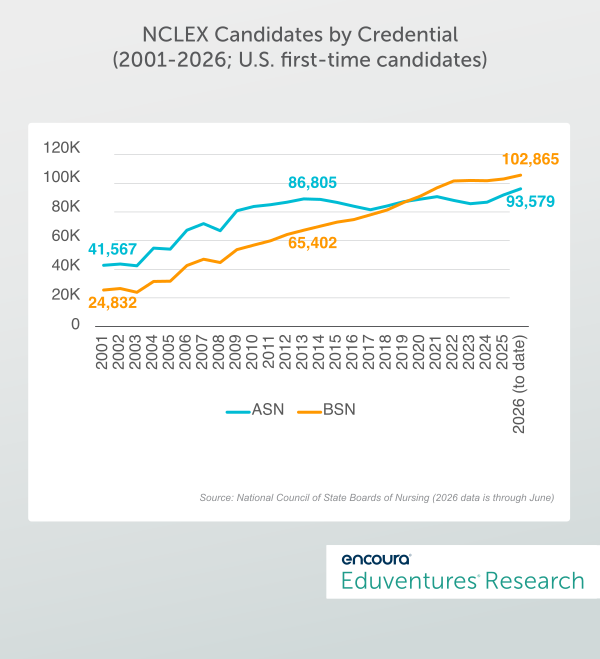
Figure 1.
It was not until 2020 that the number of first-time U.S. NCLEX candidates with a BSN surpassed those with an ASN — 55 years after the landmark ANA position paper that called for a BSN-only profession. The ASN candidate total began to fall while the BSN total surged ahead. Then something unexpected happened. In 2024, 2025, and 2026 (based on numbers through June), ASN candidate volume started to grow again and grew faster than the BSN total.
Why the Turnaround?
One reason is exam results. In 2023, the National Council of State Boards of Nursing launched the Next Generation NCLEX Exam. The new exam is designed to be a superior assessment of clinical skills and real-world situations. The exam grants partial credit for each question rather than the pass-fail model used by the previous multiple-choice version of the test.
Contrary to expectations, ASN candidates outperformed on the new exam. On the old test, ASN candidates were 6-to-8 percentage points less likely to pass than their BSN peers. But in 2024, the first full year of the new assessment, the gap closed to a little more than 1 percentage point. The gap was 1.5% in 2025.
The strong performance is attributed to the tight focus on core clinical skills in ASN programs. Word got around that the ASN was no longer a significant pass-rate handicap, boosting student interest.
ASN programs have regained some luster for other reasons, too:
- Cost: ASN programs are much more affordable than BSNs, and students enter the workplace more quickly.
- Clinicals: Required clinical hours tend to be fewer than in bachelor’s programs, easing placement bottlenecks.
- Time: Shorter programs help manage the well-documented shortage of nursing faculty.
- Flexibility: Community colleges — where ASN programs are commonplace — are more likely to offer flexible schedules that appeal to less traditional students (and these days, most students are arguably less-traditional).
These are not new ASN program characteristics. But in today’s climate of college tuition and return-on-investment anxiety, the two-year route to nursing licensure suddenly looks attractive. According to the 2024 National Nursing Workforce Survey, ASN-trained nurses earn on average $80,000, close to the BSN norm.
Nursing industry bodies continue to warn of a shortage of nurses, calling for expanded enrollment in nursing programs. Nursing unions see “nursing shortage” in terms of nurse burnout and large numbers of nurses leaving the profession, rather than the absolute number of licensed nurses or nursing students. The 2024 National Nursing Workforce Survey reported that 20% of current RNs plan to retire in the next five years, and another 18% plan to leave the profession. Stress, workload, and under-staffing were the three most cited reasons for leaving.
Whether the problem is an inadequate nursing pipeline or an off-putting work environment, ASN programs are cost-effective and help fill open nursing roles more quickly than BSN programs.
Many ASN graduates still aspire to earn a BSN — bachelor’s graduates are preferred for many higher-paid, non-bedside nursing roles — but they know that the RN-BSN route is well-established and that many employers help with tuition.
Yes, Magnet hospitals (those with the highest rating for nursing excellence) require most nurses to obtain a BSN, but it is common to still hire ASN-trained nurses and support BSN attainment over time. Yes, in 2017, the state of New York approved “BSN-in-10,” requiring all RNs first licensed from 2020 to obtain a BSN within ten years, but no other state has followed suit.
Numerous student and nurse-made videos discuss ASN vs. BSN differences, often concluding that an ASN (also known as the ADN - Associate Degree in Nursing) is a smart choice.


Figure 2.
Screenshots from two YouTube videos comparing ASN/ADN and BSN pathways.
How Should Four-Year Schools Think About the ASN Revival?
Pre-licensure BSN programs are not going anywhere and will continue to suit students who want a more traditional campus experience. A strong ASN market reduces the pressure on BSN programs to keep growing enrollment despite faculty and clinical placement limitations beyond institutional control.
Four-year schools can benefit from a stronger RN-BSN enrollment pipeline. RN-BSN enrollments fell in recent years as the number of older ASN-trained nurses interested in a bachelor’s degree dwindled. Partnerships with community colleges can steer ASN graduates toward specific RN-BSN opportunities.
Some of the largest conferrers of ASN degrees are universities, such as ECPI University, Excelsior University, Joyce University of Nursing & Health Sciences, Rasmussen University, Kaiser University, and Weber State University. Offering both an ASN and BSN may be a great option for four-year schools, if regulators allow.
Some four-year schools pitch an accelerated (three-year BSN) in an attempt to provide the benefits of a shortened program with bachelor’s cache, but the pace will not suit the typical student. Joyce University recently announced the nation’s first 90-credit BSN.
The Bottom Line
A diversified RN pipeline is a plus for the nation. Longstanding efforts by the nursing profession to push for BSN-only licensure conflict with cost and capacity pressures. If America has too few nurses, the cheaper, quicker ASN option should be celebrated. If hospitals cannot hire enough nurses, more ASN graduates are part of the solution.
The ASN revival is part of a wider trend of renewed interest in shorter and more applied programs across postsecondary education, whether certificates, associate degrees, or apprenticeships. This is a welcome redefinition of “college for all,” accommodating a broader range of students, helping to restore parental and family confidence in higher education, and countering politicization. Program partnerships and stackable credentials can keep bachelor’s degrees accessible for students who aspire to them, whether short-term or mid-career.
It is time for the nursing profession to embrace the lesson of 65 years of predicting the ASN’s demise: nursing is better off with strong ASN and BSN pipelines, which should be seen as complements not substitutes.
If your institution wants to evaluate a nursing or healthcare program portfolio or re-think credential mix and pathways more generally, please contact your Eduventures Client Research Analyst.

