


Over the last two weeks, I’ve shared two predictions for higher education in 2026: a federally imposed two-tier bachelor’s degree model and a boost to cross-border online master’s enrollment as international mobility falters.
This week, I will make my final 2026 prediction for Higher Ed—or perhaps you might call it an anti-prediction:
Prediction #3: Higher Education Spending Will Not Shift Away From People—Despite AI, Cost Pressure, and Enrollment Risk. Colleges will still NOT steer (relative) spending toward technology and away from faculty and staff (and maybe that’s smart).
Prediction #3: Higher Education Spending Will Not Shift Away From People—Despite AI, Cost Pressure, and Enrollment Risk
Over the years, whenever I wanted to challenge a company or institution that saw rapid technology-driven change on the horizon for higher education, I would show the following chart. Figure 1 tracks the share of college and university spending devoted to wages and benefits over time. It shows that despite years of investment in everything from Constituent Relation Management (CRM) systems to Student Information Systems (SIS) to Learning Management Systems (LMS) to Enterprise Resource Planning (ERP) systems —all billed as labor-saving wonders—the sector’s expenditure on labor (faculty and staff) barely budged as a proportion of the total.
Figure 1 sets out the trend for public four-year schools over the past 20 years. (The private four-year sector trend is very similar.)
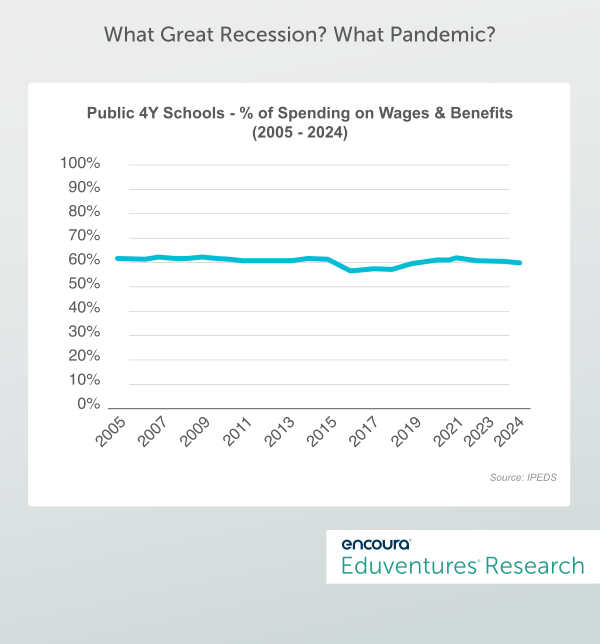
Figure 1.
What may be the world’s most uneventful chart is nonetheless striking. Despite the pain of the Great Recession and the gyrations of the COVID-19 pandemic, public schools did not waver in their proportional labor expenditure. Despite the difficulties of state funding, enrollment, and philanthropy, college commitment to employment stood firm. In the years 2023 and 2024, post-Chat GPT, and amid much fuss about radical automation via AI, higher education’s “people” spending line maintained its course.
The ratio of total students per employee actually fell recently, meaning that the average student at a public four-year school has more faculty and staff to support them. And mean wages and benefits per employee rose a bit faster than inflation in recent years. Even the full-time employee ratio has ticked up. Of course, there have been layoffs at individual colleges and universities, and federal attempts to upend funding norms caused institutional staffing headaches in 2025.
Are colleges cutting back on facility maintenance to balance the books? Is higher education employment trending more part-time and precarious? Are shared services among departments and across institutions taking up the slack? Net tuition is flat over time on average, so students are not paying more. What am I missing?
A negative reading is that higher education remains structurally resistant to process efficiencies and technological substitutions. A more charitable—and likely more accurate—reading is that leaders are adapting in ways that do not register cleanly in top-line spending ratios, finding new students, new revenue, and incremental productivity gains.
What is certain is that the data underscores that higher education is a fundamentally human-centric endeavor, whatever pundits and AI vendors might say. People are expensive (and difficult to make more productive) but seemingly essential if quality programs and student transformation are the goals. Online learning can be a boon for students, but it’s the people who make it work. Making AI useful will inevitably require a lot of people to figure it out, freeing up time for people to do valuable things AI cannot.
Notably, even a giant, fully online school like Western Governors University reports a similar and stable people-spend ratio—albeit at a lower per-student spend overall.
I usually predict that things will change and be disrupted. But here, I predict NO CHANGE. Despite another year of AI commotion, federal pressure, and enrollment uncertainty, the 2025 people expenditure data will be unmoved.
How institutions pay for this stubbornly people-centric enterprise is the real disruption—and the answer—as laid out in Prediction #1—likely lies in credential structure rather than cost-cutting. If higher education changes in 2026, it will be in what it offers and who it serves, not in how much it relies on people to do the work.

