


Last year, from the admittedly hazy vantage point of early January, I set out three predictions for higher education in 2025:
- Prediction #1: The number of fully online undergraduates will surpass the “campus-only” cohort for the first time.
- Prediction #2: U.S. Department of Education will become collateral damage in the first year of Trump’s second presidency.
- Prediction #3: Grad PLUS loans will be eliminated, and schools will be on the hook for unpaid student debt.
Turns out I was wrong, right, and part-right. Taking each prediction in turn, let’s evaluate what happened.
Review of Prediction #1: The number of fully online undergraduates will surpass the “campus-only” cohort for the first time.
Alas, my first prediction did not come to pass. Fully online undergraduate enrollment grew to a record 4.7 million students in 2024, but the “campus-only” cohort (5.5 million) grew faster (1% and 2% year-over-year respectively). Undergraduates who combine online and campus courses grew fastest (3% year-over-year).
What does this mean?
My prediction discounted the post-pandemic revival of campus-only students, which is obvious in the 2022 and 2023 data. This trend continued in 2024 but appears to be peaking. Campus-only undergraduate enrollment grew by 2% in 2024 compared to 11% the prior year and 50% the year before that. Growth in the size of the high school graduating cohort aided campus-only momentum.
But if 2024 is close to the new-normal post-pandemic, that leaves campus-only enrollment of more than three million students or 37% below the pre-crisis total. Fully online headcount ticked up a mere 1% in 2024, but that is still 1.2 million (36%) higher than the pre-pandemic baseline.
Fully online enrollment may be slowing down and has yet to surpass the campus-only total, but the latest figures nonetheless represent a dramatic modality shift.
It is instructive to look at year-over-year growth by online enrollment scale (Figure 1).
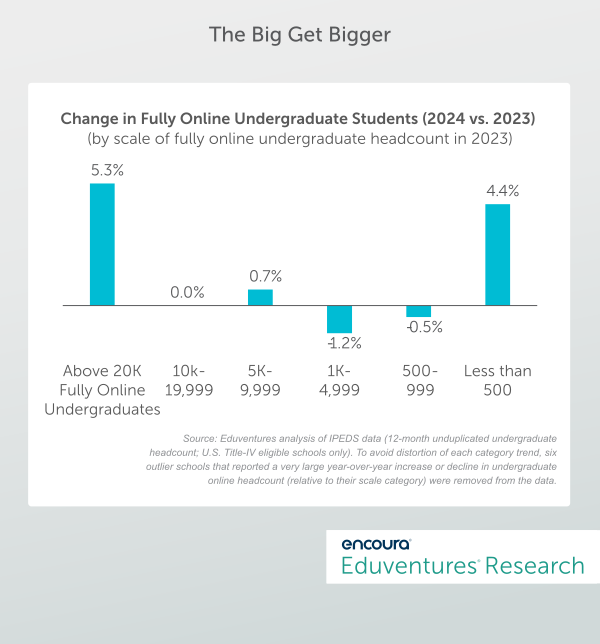
Figure 1.
Figure 1 spotlights that the “online giants” continue to take market share. Just 22 schools reported 20,000+ fully online undergraduates in 2024 but commanded almost 30% of the market and grew faster than average. Yes, schools with fewer than 500 fully online undergraduates also saw above-average growth, but these nearly 1,500 institutions have only 5% market share and a mean of just 163 fully online students.
The other four school categories show signs of maturation: holding the line but struggling to sustain growth. Of course, individual schools out- or underperform, but fully online programming for undergraduates may have reached a new demand plateau.
What’s next?
Economic uncertainty is fueling student demand, which may push more adult learners into convenient online programs. Younger students will continue to opt for campus-based experiences with a few online courses. Cratering international student demand may persuade more schools to pivot to online programs to try to make up the shortfall.
As our latest Changing Landscape of Online Education (CHLOE) Report (produced in partnership with Quality Matters and EDUCAUSE) demonstrates, the online market is more crowded than ever.
The big question is whether AI, simulations, personalized learning, or other pedagogic innovation can take the online student experience to another level any time soon. Interesting experiments aside, I do not see much evidence so far.
Innovation at scale is needed for the fully online undergraduate sector to achieve another market breakthrough. In 2024 — contrary to my prediction — campus-only (and hybrid) enrollment outpaced fully-online. How schools take strategic advantage of this growing hybrid trend — for example, leveraging technology to expand student access to off-campus work experience and moderating dependence on expensive physical infrastructure — should be a major agenda item for higher education leaders in 2026 and beyond.
Evaluation of Prediction #2: U.S. Department of Education will become collateral damage in the first year of Trump’s presidency.
According to Linda McMahon, U.S. Education Secretary, in October 2025: “Millions of American students are still going to school, teachers are getting paid, and schools are operating as normal. It confirms what the president has said: the federal Department of Education is unnecessary.”
In short, I was right on this one. The U.S. Department of Education still exists but is a shadow of its former self. Between major cuts in March and a smaller reduction in force (held up in the courts) in October, about half the department’s staff (over 2,000 people) have been let go. The cuts impact K12, special education, and adult education, as well as postsecondary.
Secretary McMahon casts the department as wasteful, meddling, and ideologically captured. She is committed to a “momentous final mission” to return education to the states by tearing up red tape, throwing out needless functions, and pivoting core activities to other agencies.
In November, the department announced new agreements with the Departments of Labor, Health, Interior, and State to assume various departmental roles. For example, the Department of Labor will now manage a long-list of programs previously under the purview of the Office of Postsecondary Education. Programs include TRIO (support services for K12 and college students from disadvantaged backgrounds), various HBCU initiatives, and the Fund for the Improvement of Postsecondary Education (FIPSE) — a longstanding grant to spur innovation in higher education.
The Secretary has acted swiftly, rendering Congress (with ultimate authority over the department) a nervous bystander. The Secretary has assured that all statutory duties will be maintained. The department is positioned to oversee the new inter-agency arrangements. Indeed, such agreements are presented as a normal way of doing business across the federal government.
What does all this mean for colleges and universities?
There are no signs of disruption to the lifeblood of the higher education system: Pell grants and student loans. FAFSA filings are ahead of schedule. The Secretary has been careful to swing her ax at optional initiatives and discretionary oversight rather than funding fundamentals.
Despite deep cuts to staffing at the National Center for Education Statistics, core data sources maintained by the department (such as IPEDS) appear unaffected, while many longstanding nice-to-have studies (e.g., National Postsecondary Aid Study) have been deemed disposable. New mandates for institutions to report on student outcomes and admission demographics did not stay the Secretary’s hand.
Colleges and universities are reeling from multiple other federal disruptions (e.g., slashed federal research grants, frozen funding and “fines” for elite schools over alleged discrimination, increased scrutiny of international students), but the Department of Education is only a bit-player.
Not Just “Collateral Damage”
It would be naive to think that bigger changes are not on the horizon.
The Fact Sheet about the inter-agency agreement with the Department of Labor promises a “better coordinated Federal approach to postsecondary education and workforce development to help more Americans achieve career success.” In August, three departments (Commerce, Education, Labor) released a joint Workforce Development Strategy to drive the reindustrializing of America, address skills shortages, and prepare workers for the AI-driven economy. The document says that college-for-all has “failed,” millions of Americans are disconnected from high-wage jobs and career paths, and that identifying alternatives to the four-year degree is a priority.
This is a vision for a smaller bachelor’s-focused higher education system and a ramped up non-degree and two-year sector. “Workforce Pell” will launch in July 2026, making Pell grants available to non-degree programs as short as eight weeks. One of the four priority areas under the latest FIPSE grant cycle (applications closed in early December) is “supporting capacity-building for high-quality short-term programs” ($50 million available).
For most colleges and universities, the U.S. Department of Education is vital in terms of FAFSA, Pell, and student loans, but in other respects is rarely mission critical. The agency is a source of valuable special purpose but ultimately discretionary funds.
New federal coordination is emerging around degree alternatives and alignment of postsecondary investments and workforce development. The U.S. Department of Education will continue to circle the drain while more functions are handed off. The more important story for colleges and universities is the federal paradigm shift from education to the workforce.
And what about Prediction #3? You’ll have to wait until next week…

Dive into the top 5 digital marketing trends that will lead higher education in 2026.
