

What if families decide your college is too expensive before they ever learn what it would actually cost them? That is increasingly the challenge facing enrollment teams: 72% of families eliminate colleges early based on sticker price — even though published tuition often bears little resemblance to what many students ultimately pay.
After two decades of rising college prices and growing questions about the value of a degree, families are making affordability judgments earlier in search. For institutions, the challenge is no longer simply demonstrating affordability after admission. It is preventing sticker price from ending the conversation before it begins.
Families Are Making the Price Decision Early
The traditional financial aid process assumes institutions eventually get an opportunity to explain price: students apply, institutions determine aid, and families compare their options.
The 2025 Prospective Family Engagement Report from RNL (now part of Encoura), Ardeo, and CampusESP found that 72% percent of families eliminate schools early based on sticker price, while Sallie Mae’s How America Pays for College report puts a similar figure even higher (83%). At the same time, 61% of families report stress about borrowing.
This means institutions may be losing prospective students before they have an opportunity to communicate the number that matters most: what an individual family might actually pay. And the gap between published and actual price can be considerable.
20 Years of Rising Prices Have Raised the Stakes
Families did not develop this sensitivity to price in a vacuum. The published cost of college has changed dramatically over the past two decades. Figure 1 charts published tuition and fees at four-year institutions between 2005 and 2025.
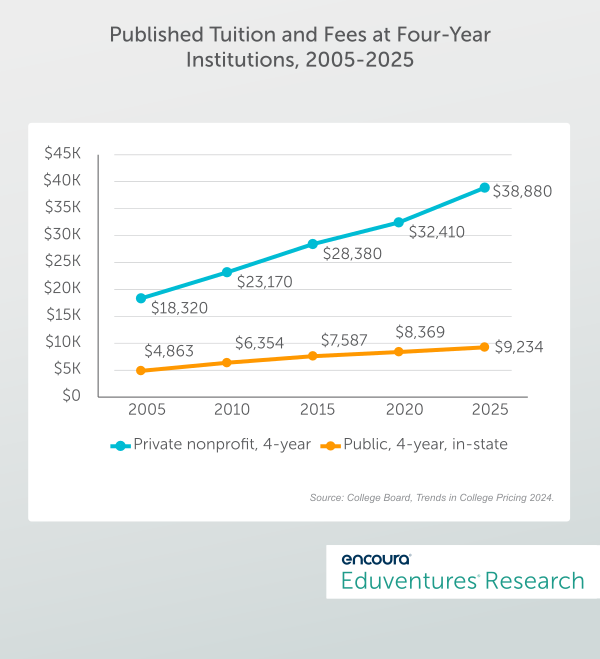
Figure 1.
Between 2005 and 2025, published tuition and fees at private, nonprofit, four-year institutions increased from $18,320 to $38,880. Public, four-year, in-state tuition and fees rose from $4,863 to $9,234.
Over those 20 years, tuition grew at an annual rate of 3.8%, compared with 2.5% for the Consumer Price Index. To keep families' net cost flat over this period, the average tuition discount rate would have needed to rise from 37% in 2005 to 70% in 2025.
The result is an increasingly complicated pricing environment: Published prices have risen substantially even as the price many students ultimately pay can be considerably lower. That widening disconnect raises the stakes for institutions trying to remain in families' consideration sets.
Price Is Also Being Judged Against Value
There is another reason families may be less willing to wait for the full financial aid picture: Confidence in the underlying value of higher education has weakened. Figure 2 charts the share of U.S. adults expressing a “great deal” or “quite a lot” of confidence in higher education from 2015 to 2025.
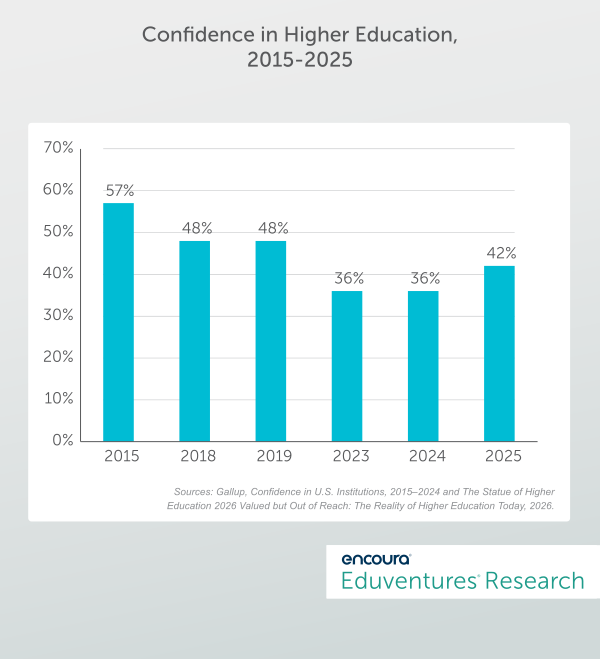
Figure 2.
In 2015, 57% of U.S. adults expressed a “great deal” or “quite a lot” of confidence in higher education. By 2023 and 2024, that figure had fallen to 36%. Confidence rebounded to 42% in 2025 but remains well below its level a decade earlier.
Only 22% of U.S. adults now say having a four-year degree is extremely or very important to getting a well-paying job, down from 40% in 2013.
Yet families have not abandoned the college aspiration. According to the Pew Research Center, more than 70% of parents still expect their child to attend a four-year college, and the majority still believe college will help their child achieve a better life than they had.
This is an important distinction. Families still want college but are becoming much more selective about which college is worth the price.
From the Value of College to the Value of Your College
The economic case for higher education remains substantial. In 2024, households led by someone with a bachelor's degree or higher had median income 2.3 times that of households led by someone with a high school diploma but no college. Adjusting for inflation, median household income for bachelor's degree holders grew 13.1% between 2004 and 2024, while income for high school graduates remained essentially flat.
But those statistics demonstrate the value of a bachelor's degree in general. Families are making a much more specific decision: they are deciding whether your institution at your price represents a worthwhile investment.
A national earnings statistic cannot tell a family whether a $50,000 institution offers greater value than a $30,000 alternative. Institution-wide employment figures often do not tell a prospective nursing, psychology, business, or computer science student what graduates from that particular program experience.
The institution therefore has two jobs: make sure families understand what they are likely to pay and give them evidence of what that investment can deliver.
The Bottom Line
If families are removing institutions from consideration based on sticker price, the affordability strategy has to move upstream. Here are three ways to do that:
- Put realistic price information upstream. Make net-price tools, representative examples, and scholarship information prominent before application — not just after admission.
- Give families a reason not to rule you out. If your sticker price overstates what many students pay, explain that clearly at the points where families are building and narrowing their lists.
- Prove the value of your price. Connect cost to program-level outcomes, career pathways, starting salaries, first-job rates, and alumni examples wherever reliable data are available.
The danger for institutions isn't simply that families think college costs too much. It's that they may decide your college costs too much based on a price they would never actually pay — and remove your college from consideration before learning either what your college would cost them or what that investment could deliver.

