

International students have long been a lifeline for institutions struggling to fill their fall undergraduate classes and meet tuition goals. But that pipeline is becoming less reliable. Between 2019 and 2025, international undergraduate enrollment in the U.S. declined by nearly 15% amid pandemic disruptions and tightening visa policies.
Yet visa concerns only tell part of the story. The international students still choosing the U.S. are changing as well.
Today’s international prospects are increasingly cost-conscious, less likely to have family financial backing, and more focused on career outcomes. For many, a U.S. education is no longer simply a prestige purchase — it is a high-cost investment whose return must be justified.
The ROI of a U.S. Education
International students are ineligible for federal financial aid but are also rarely included in institutional discounting. This makes the United States an expensive destination for globally mobile students.
Even so, strong academic reputations and the promise of the “American Dream” have helped the U.S. maintain its position as a top destination for international students, particularly at the graduate level where optional practical training (OPT) remains a major draw. However, international undergraduate enrollment has remained flat and below pre-pandemic levels.
Visa worries only tell part of the story. The Eduventures Admitted Student Research™ reveals a sharper shift: international students are placing greater emphasis on affordability and career outcomes when choosing where to enroll. Figure 1 shows affordability becoming substantially more important in enrollment decisions between 2019 and 2025, even if it is not the primary driver of final choice.
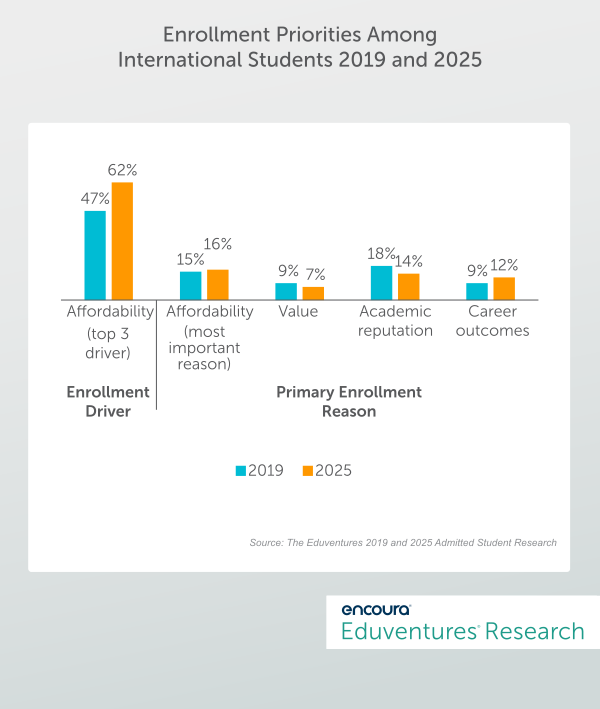
Figure 1.
In 2019, nearly half of international students listed affordability among their top three enrollment criteria. By 2025, that figure had grown to almost two-thirds of students. Despite this rise in relevance, affordability saw only a modest increase as the single most important enrollment reason. Career outcomes, meanwhile, increased in importance and now outranks affordability as a deciding factor.
This means that cost matters to international students — but primarily as part of a broader return-on-investment calculation. When U.S. institutions compete head-to-head for international students, career preparation, employment opportunities, and pathways like OPT are becoming central to how students assess value.
Footing the Bill
The affordability shift becomes even more striking when looking at who today’s international students are. Between 2019 and 2025, the Eduventures Admitted Student Research shows a 20-percentage point increase in students reporting household incomes below $50,000 — an income range that would qualify many for Pell grants if they were U.S. residents. Meanwhile, the proportion reporting household incomes of $150,000 or more declined by 9%.
Some of these shifts reflect changing geographic markets. Enrollments from China, for instance, have declined significantly, while countries such as Ghana and Bangladesh are sending more students to the United States than before.
For many international students, a U.S. education is an expensive investment. Without access to federal financial aid and with limited work authorization, students and their families are often expected to absorb the full cost. Increasingly, however, international prospects are uncertain if their families can — or will — do so. Figure 2 shows how expectations for parental support shifted between 2019 and 2025, according to the Eduventures Prospective Student Brand Research™.
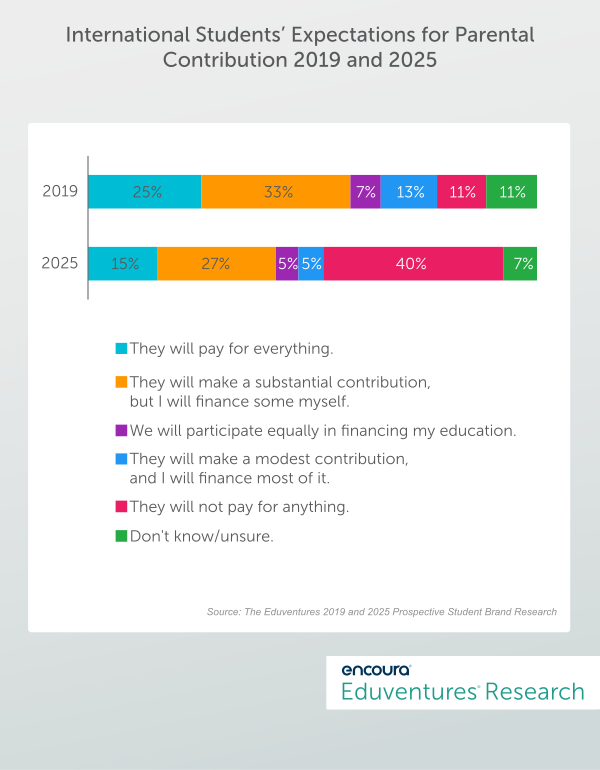
Figure 2.
In 2019, more than half of international prospects expected their parents to foot most of their education bill. By 2025, this proportion had shrunk by 16 percentage points. More strikingly, the proportion of international students expecting to fund their education entirely on their own rose from 11% to 40%.
Not surprisingly, international student hopes for merit- and need-based aid are surging (merit aid 68%, up from 60%, and need-based aid 62%, up from 52%). Yet, these funding opportunities remain limited and highly competitive, further complicated by visa requirements that demand proof of financial support. Students who cannot secure funding may look to more affordable destinations outside the United States.
The Bottom Line
International undergraduate enrollment is unlikely to rebound simply because visa conditions improve. The students still choosing the U.S. are increasingly different from those who came before — less affluent, less likely to have family financial support, and more focused on career outcomes and return on investment.
Many institutions, however, continue to treat international students primarily as a source of tuition revenue rather than as a population with growing financial need and rising expectations around career outcomes.
For institutions to remain competitive in this market, several shifts are becoming steadily important:
- Career outcomes are now table stakes. International students are not simply shopping for prestige — they are calculating ROI. Institutions that speak concretely about employment outcomes, OPT pathways, and career services will have an edge over those still leaning on reputation alone.
- Silence on cost is more and more risky. Institutions offer limited merit aid to international undergraduates and communicate little about affordability. Yet nearly 40% of international prospects now expect to fund their education entirely on their own. Institutions that fail to address affordability directly risk pricing themselves out of consideration.
- The international student pipeline may become more resource-intensive. Recruiting international students requires stronger advising, clearer value propositions, and more targeted financial support than ever before. Institutions may need to reconsider whether their current recruitment strategies — and investments — still align with market realities.
The international student market is shifting. Institutions competing for these students may need to rethink long-held assumptions about who international students are, what they value, and what they can afford.
At Eduventures Summit 2026, we will continue exploring the data and discussing whether international undergraduate students are still a feasible pipeline. We hope you join us in Chicago!

