
Colleges and universities are incredibly sophisticated at managing their undergraduate enrollment funnels. They know who is inquiring. They know who is applying and when. And they know how important financial aid is in the process. Yet the underlying student decisions that drive yield remain elusive, just as competition for every student grows fiercer.
Why?
Because institutions understand the waypoints of the enrollment path, but not the fullness of the student journey itself. New Eduventures analysis following the same students from application through enrollment shows why that matters: Most students enter the funnel with only a rough draft of what they want from college. To stand out, institutions must adapt recruiting to help them develop it.
Expect Evolution
Do we really expect the average teenager to know exactly what they want from college? When Eduventures research followed the same students from application to enrollment, we found that 44% remained consistent in what they wanted — but 56% evolved.
Over the past five years, 4,333 students responded to both the Eduventures Prospective Student Brand Research™ and Admitted Student Research™ within the same enrollment cycle. This allowed us to see not just where students started and landed, but how their priorities evolved in between.
Figure 1 shows how students’ Mindset orientations changed between application and enrollment. We grouped students into three broad orientations based on the Eduventures Student Mindsets™: career-oriented students prioritize landing a job or building a career; life experience-oriented students seek friendships and opportunities to make an impact; and academic-oriented students prioritize academic quality and preparation for graduate school or a lifelong career.
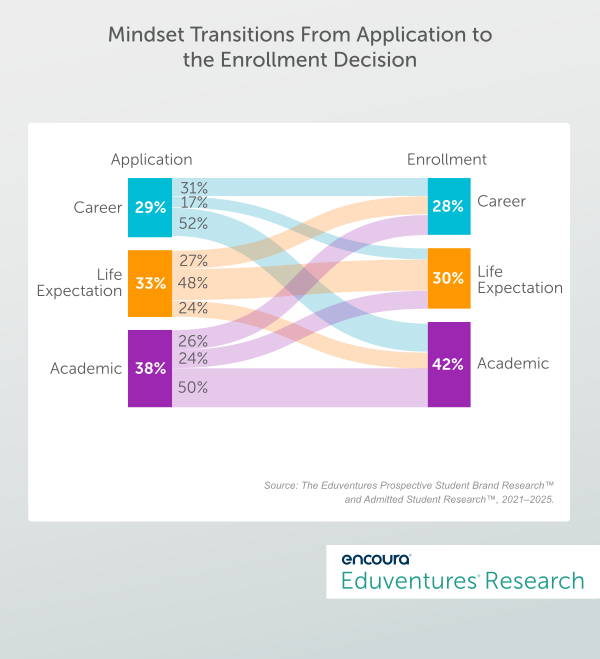
Figure 1.
At first glance, surprisingly little changes. Career orientation moves from 29% to 28%, life experience from 33% to 30%, and academic from 38% to 42%.
Follow individual students, though, and a very different picture emerges. More than half of career-oriented applicants (52%) become academic-oriented by the enrollment decision. Life experience- and academic-oriented students are more stable, but even among these groups, only 48% and 50%, respectively, maintain the same orientation.
The funnel may look stable. The students inside it are not.
Those flows resolve into four distinct journeys: one group whose Mindset orientation remains consistent, and three groups that evolve toward academic, career, or life experience priorities. We’ve given each one a name to remind us that behind every percentage is a person:
- Stable Suzy (44%) — Confirmation, Not Transformation. Arrives knowing what she wants and chooses among the highest-quality options.
- Academic Ali (23%) — Discovering the Importance of Academics. Arrives with the highest career anxiety and crystallizes an academic identity by enrollment, driven in part by growing interest in research.
- Career Cora (19%) — Financial Reality Brings Focus to Career. Arrives with the highest shares of first-generation and lower-income students and trades early social priorities for greater emphasis on career skills and job outcomes.
- Experience Edward (14%) — Came for the Quality, Stayed for the Community. Arrives focused on prestige and rigor, then turns toward the community where he feels he belongs.
A forthcoming Eduventures report explores all four journeys. Here, we focus briefly on Career Cora because her path illustrates how circumstances can reshape what a student wants from college.
Meet Career Cora
Cora is the most financially vulnerable of the four groups. At 34%, her journey has the highest share of first-generation college students and those from households earning less than $50,000 (27%).
At application, academic strength (53%) and affordability (52%) are nearly equal priorities. But her interest in social environment is what sets her apart: 46% of students like Cora select it, compared with 33% of other students.
Then her priorities shift. Affordability rises 9 percentage points as a decision driver, while social environment falls 17 points. Yet, Cora doesn’t stop caring about belonging. The share identifying the chosen school as friendly and community-oriented rises 13 points. And even as academic strength declines four points as a decision driver, perceptions of the chosen school as high quality and challenging increase three points.
Financial reality forces Cora to make a trade-off, but she doesn’t stop caring about college life. What changes is what she can afford to put first: by the enrollment decision, she increasingly needs college to lead to a career.
Can You See the Coras in Your Funnel?
Her file offers clues. Financial aid information may reveal how little her family can contribute, and she’s more likely than other students to be the first in her family to attend college. But the surest way to understand how her thinking is changing is to ask — and keep asking.
A counselor’s question during a campus visit, a one-question text after her aid offer arrives, or a chatbot that notices her questions shifting from housing and clubs toward cost and careers can all reveal the shift from “Will I fit in here?” to “Will this pay off?”
Then respond. Make costs clear across all four years. Show her the career outcomes of the majors she’s considering. And remember she still wants friends and community, so point her to affordable ways to belong, like on-campus jobs, first-generation student groups, and career-focused clubs.
The Bottom Line
This unparalleled look at student journeys tells us something the enrollment funnel cannot: Mindsets evolve for most students and that evolution is not random. It resolves into four distinct, identifiable journeys. Move from marking the path, which is institutionally focused, to guiding the journey, which is student focused:
- Understand what students are thinking, not just where they are in the funnel. Behind every funnel stage is a student still working out what they want from college. Knowing what students are thinking lets you support them, and a student who feels supported is more likely to choose you.
- Don’t just make the class; be a real enrollment partner. Being a partner means walking alongside students through the hard moments: when an aid offer falls short, a major no longer fits, or they aren’t sure they belong.
- Build a responsive dialogue on top of sophisticated communication. Segmented and targeted outreach is a strong start, but students’ questions, replies, and behaviors should shape what you say next.
- Don’t just sell fit; support deliberation. A student isn’t making their enrollment decision in a vacuum. Your institution is one option among several, each being measured against the student’s imagined future. Genuine support means helping them through that decision.
- Earn a confident decision, not just a deposit. A deposit tells you what a student did, not what they believe about their choice. Confidence in that decision is built long before they commit. Students who feel heard and supported arrive on campus more connected to the institution and more invested in their decision.
Manage the funnel, but don’t mistake it for the journey. Suzy, Ali, Cora, and Edward are all in your funnel right now, each still learning what college can be for them — and giving you opportunities to help guide the way.
Read more about Stable Suzy, Academic Ali, and Experience Edward in our forthcoming Eduventures report Charting Their Own Course: How Students Navigate the Enrollment Journey. Look for it in the Encoura Platform Research Library this month.
